



Horsepower or Drawbar Pull? What Actually Matters When You Buy a Tractor
Walk onto any tractor lot and the first number a salesman will throw at you is horsepower. 50 hp. 90 hp. 120 hp. It's the big figure on the brochure, the one everyone quotes, the number that somehow became shorthand for "how strong is this thing."
But spend a season behind the wheel pulling a plow through wet clay, and you'll learn a truth that no spec sheet tells you upfront: horsepower is what the engine makes. Drawbar pull is what actually gets the work done. And the gap between those two numbers can be the difference between a tractor that glides through the field and one that sits there spinning its wheels.
If you're in the market for a tractor — whether it's your first one or you're upgrading — this guide breaks down what horsepower really means, why traction matters just as much (and sometimes more), and how to match the right numbers to the actual work you do.
The Three Horsepower Numbers Nobody Explains
Here's the first problem. "Horsepower" isn't one number. It's at least three, and manufacturers love to advertise the biggest one while you need the smallest one to make real decisions.
Engine Horsepower (Gross HP)
This is the raw power the engine produces on a test stand, before anything else in the tractor drains it. It's the number on the front of the brochure. A 100 hp engine sounds great — until you realize that by the time that power travels through the clutch, transmission, final drives, and out to the wheels, you've lost a meaningful chunk of it.
PTO Horsepower
PTO stands for Power Take-Off — that splined shaft at the back of the tractor that runs mowers, balers, rotary tillers, grain augers, and anything else with its own working parts.
PTO horsepower is what's left after the engine's power passes through the transmission. As a rough rule of thumb, PTO hp runs about 75–85% of engine hp, depending on the transmission design.
Drawbar Horsepower
And now we get to the one that actually moves dirt. Drawbar horsepower is the power available at the hitch point — the pulling force that drags a plow, disc, cultivator, or heavy trailer through the field.
Why Traction Can Matter More Than Horsepower
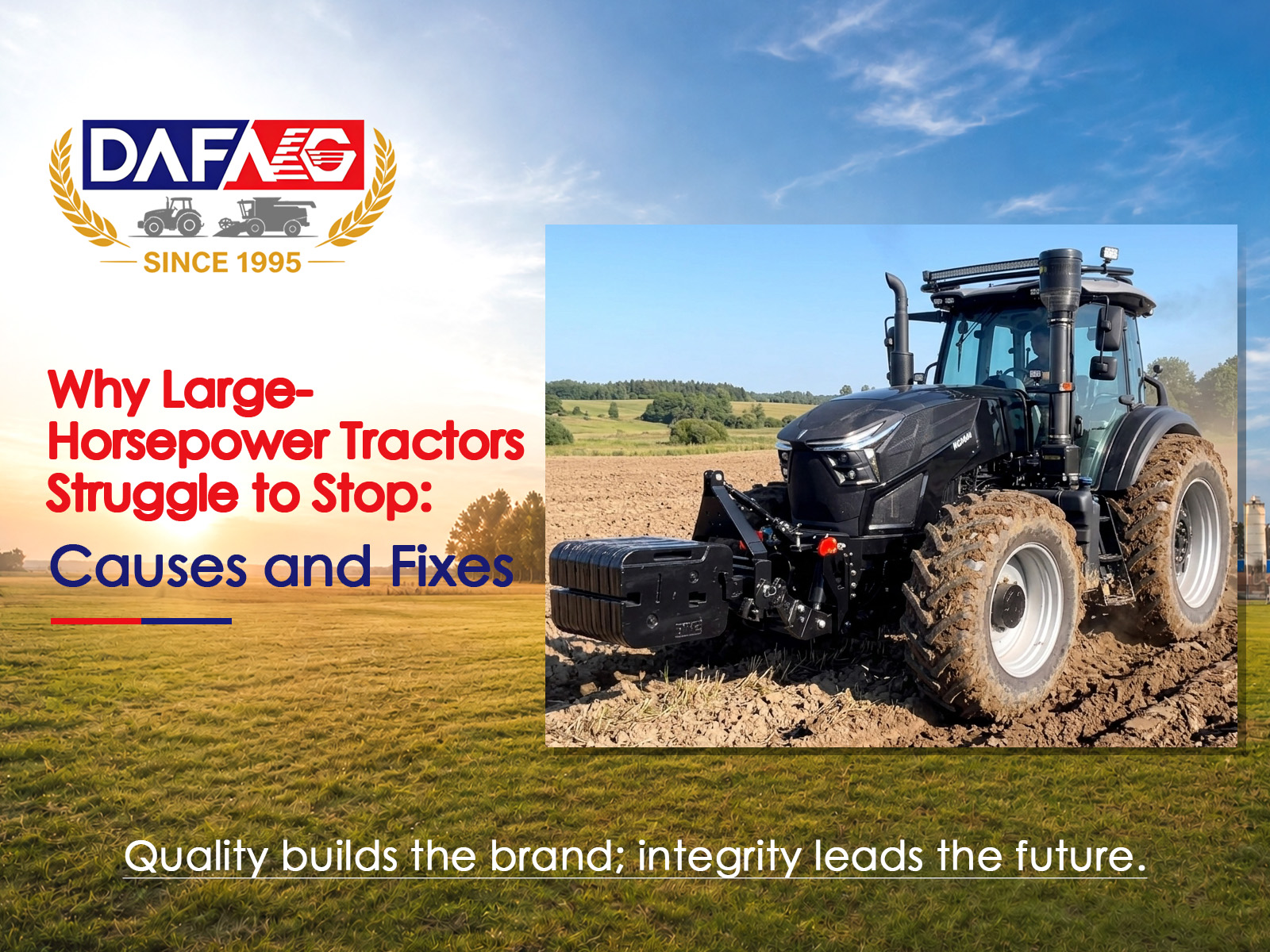
Here's the part that surprises first-time buyers: a tractor's maximum pulling force isn't limited by its engine. It's limited by traction.
The formula is brutally simple: Drawbar Pull = Weight on Driving Wheels × Coefficient of Traction
The Weight Factor
This is why tractor weight and ballast matter so much. Extension services and tractor manufacturers generally agree on optimal wheel slip targets:
- MFWD / 4WD tractors: around 10% slip
- 2WD tractors: 13–15% slip
- Track tractors: around 6% slip
4WD vs 2WD: The Traction Multiplier
If traction is the name of the game, then drive type is your single biggest lever. Research from the Japan International Research Center for Agricultural Sciences found that a 4WD tractor's maximum drawbar pull is roughly 1.4 to 1.6 times that of a 2WD tractor at the same slip rate.
Matching Numbers to Real Work
If You Run PTO Implements Most of the Time
For this kind of work, PTO horsepower is the number that matters. Check the implement's manual for its minimum PTO hp requirement. Then buy a tractor that exceeds it by 10–15%.
If You Pull Ground-Engaging Implements
Plows, disc harrows, cultivators, subsoilers, land planes — these care about drawbar pull and drawbar horsepower.
The Specs That Actually Tell You About Traction
| Spec | What It Tells You |
|---|---|
| Operating weight | More weight = more traction potential |
| Wheelbase | Longer = better weight distribution |
| Tire size & type | Bigger footprint = better traction |
| 4WD / MFWD | Adds 40–60% more drawbar pull |
| Differential lock | Essential in slippery conditions |
| Transmission | PowerShift/CVT maintains torque better |
| Drawbar pull rating | The most honest pulling number |
Common Mistakes That Cost Real Money
Mistake 1: Buying on Engine HP Alone. Always ask for PTO hp and, if available, drawbar pull.
Mistake 2: Ignoring Tire Condition and Pressure. Lower tire pressure = larger contact patch = more traction.
Mistake 3: Under-Buying. Leave room to grow, but don't over-buy for your acreage.
Mistake 4: Forgetting Fuel Efficiency. Proper ballast and tire pressure save you money at the pump.
The Bottom Line
Horsepower sells tractors. Traction farms the land.
Look at PTO hp for PTO implements. Look at drawbar pull and operating weight for tillage and heavy hauling. Get 4WD if you'll work in soft soil. Pay attention to tires and ballast — they're cheap compared to a second tractor.
If you're trying to size a tractor for a specific implement or farm size, drop the details in the comments or get in touch — we're happy to help you run the numbers before you buy.