



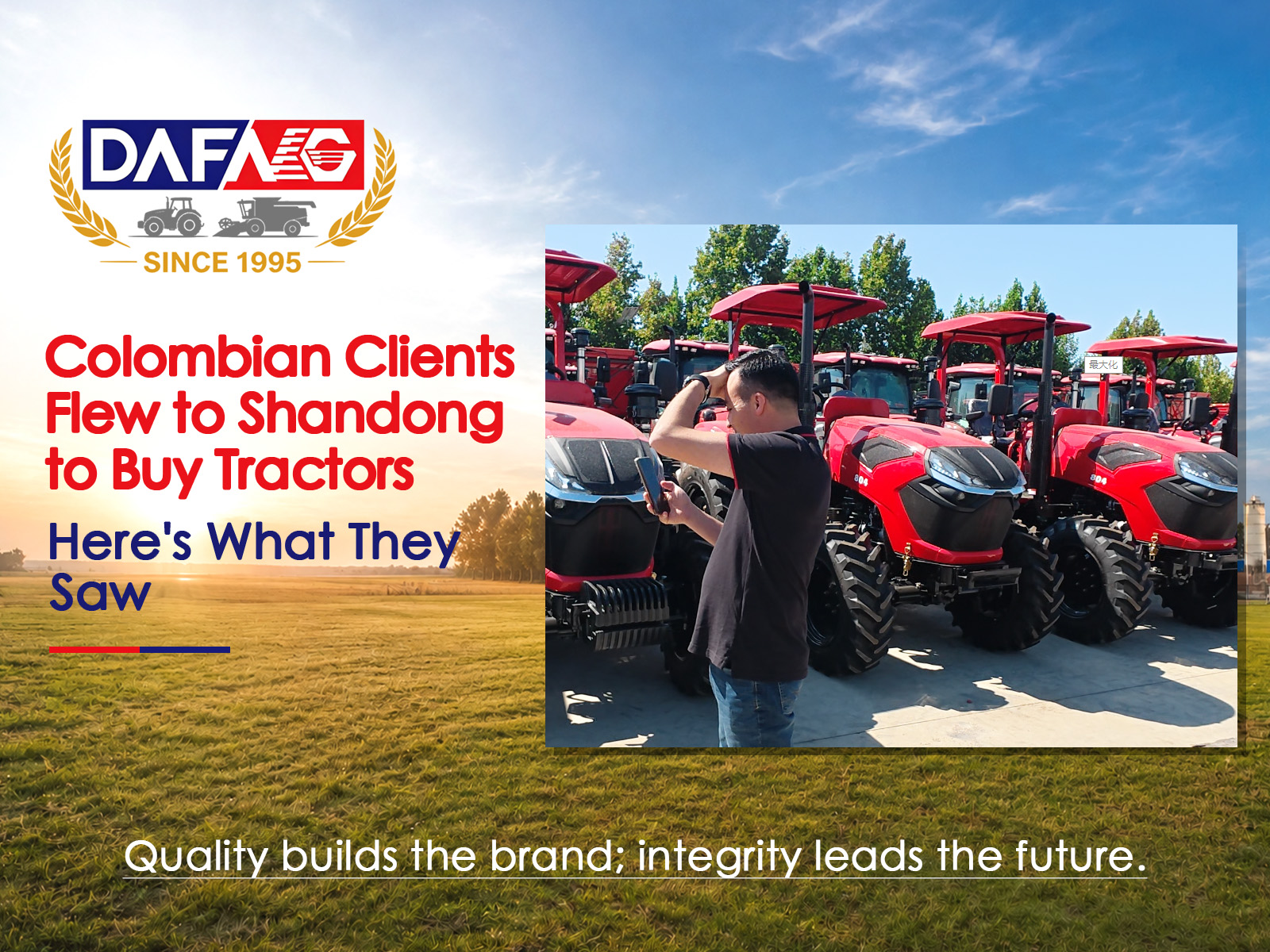
Colombian Clients Flew to Shandong to Buy Tractors. Here's What They Saw
A delegation of agricultural equipment buyers from Colombia landed in northern China last month with one clear goal: see for themselves who Golddafeng really is, and whether the tractors carrying the Golddafeng name on South American farms are as solid as the dealers say they are.
They left the Shandong factory with a signed purchase order in hand.
This isn't a one-off "factory visit" press release. Over the past three years, buyers from Brazil, Peru, Chile, Bolivia, and now Colombia have made the long trip to Golddafeng's headquarters in Yanzhou, Jining — one of China's oldest and densest agricultural machinery clusters. What keeps bringing them back is simple: the tractors hold up under local conditions, and the parts and service chain doesn't leave them stranded mid-season.
This article walks through what the Colombian team actually inspected, why a Chinese manufacturer with 32 years of tractor-building experience keeps winning orders in South America, and what it means for Colombian farmers and distributors looking for a reliable tractor supplier.
Who Came, and Why It Matters
Colombia is not an easy market for imported tractors. The Andes cut the country into three mountain ranges. Coffee lands sit on steep hillsides. Palm oil and rice farms stretch across the lowlands on the Caribbean side. Rainy season lasts six months on the coast. Temperatures swing from frost-level in the highlands to 35°C-plus in the plains.
A tractor that works in Iowa or northern Germany does not automatically work in Meta or Córdoba. Buyers know this. That's why the Colombian delegation — two distributors and a large palm-oil producer — didn't just watch a product demo online. They wanted to walk the production line.
They spent two days on site. They checked the welding on the chassis. They watched a tractor go through the dynamometer test. They opened the hood on a 130hp model and asked about the engine coolant routing. By the end of the second day, they had spec'd out the order: a mix of mid-horsepower tractors for mixed farming and a smaller batch of lighter units for coffee-region work.
32 Years of Tractor Manufacturing — What That Actually Means
Golddafeng started in 1995. That makes 2026 its 32nd year in business.
Thirty-two years in tractor manufacturing is not a marketing line. It shows up in small ways that only a farmer or mechanic would notice:
- Structural Integrity: The welds are not decorative. Chassis rails are thicker than what you'll find on most export-spec tractors from smaller Chinese factories.
- Hydraulic Power: The hydraulic valves are sized for real implements. Golddafeng specs its mid-range units to run heavy disc harrows and loaders without starving the system.
- Supply Chain Control: Spare parts are internally stocked, not outsourced. The company runs its own foundry and machining for core components.
Built for South American Soil and Climate
This is the part that keeps coming up in every South American buyer conversation: will this machine survive our ground?
Heat, Humidity, and Dust — Solved at the Source
The cooling package is upsized. Radiator cores and fan airflow are spec'd for sustained 35–40°C ambient temperatures, so the tractor doesn't lose power or overheat during long days on the flat plains. Anti-corrosion coatings on the chassis and undercarriage are upgraded for coastal and rain-exposed operation.
Clay Soils and Hillside Farms
Front axles are reinforced for the lateral load of hillside work. Tire options include deep-tread R-1W patterns that grip red clay better than the standard agricultural tread. The rear axle ratio and hitch lift capacity are tuned so a 120–140hp unit can pull a heavy offset disc or subsoiler without bogging down.
Compatible With Implements Your Neighbors Already Use
The tractors run standard Category I and II three-point hitches and open-center hydraulic systems that work with the disc harrows, plows, seeders, and front-end loaders already on Colombian and Brazilian farms.
Quality You Can Verify Before You Buy
- Raw material inspection on every steel batch.
- In-process checks on every machining operation.
- Assembly-line torque verification on critical joints.
- Full dynamometer, hydraulic pressure, PTO, and brake testing on every finished unit.
- A final road and function check before crating.
Parts and Service, Without the Six-Week Wait
- Regional parts warehouses mean core wear items are on the ground.
- Standard parts orders reach most South American destinations inside seven days.
- Field engineers make regular trips to train dealer technicians.
- Standard warranty on export units runs two years.
Talk to the Golddafeng Team
If you're a farmer, distributor, or agricultural cooperative in Colombia or elsewhere in South America evaluating tractors for local conditions, the Golddafeng export team can walk you through the right horsepower range, the implement compatibility list, and current lead times.
Request a quote for tractors built for South American conditions, or explore the full tractor lineup from 70hp to 220hp to find the right fit for your operation.
Golddafeng Machinery — 32 years of focused tractor and harvesting equipment manufacturing. Shandong, China. Exporting to 80+ countries worldwide.